
Thailand Media Landscape 2025–2026
- ธันวาคม 29, 2568
- Thailand Media Landscape 2025 - 2026
Thai Media 2025–2026: How AI and Consumer Behavior Are Changing the Game
The challenges facing Thailand’s media industry in 2025–2026 have intensified as competition for consumers’ time and attention grows within an increasingly fragmented media ecosystem. The rising influence of content creators, influencers, and social media platforms—now primary sources of news and entertainment—has placed sustained pressure on traditional and professional media organizations to accelerate structural transformation, rethink revenue models, and adapt content strategies. These changes are unfolding amid ongoing economic uncertainty, the continued migration of advertising budgets toward digital platforms, and mounting concerns over trust and credibility, which have become central to competition in an era of information overload.
Within these challenges lie opportunities for media organizations and brands that can adapt effectively. These include creating content tailored to highly specific interests, designing cross-platform media experiences, and leveraging AI to enhance efficiency across content production, distribution, and monetization.
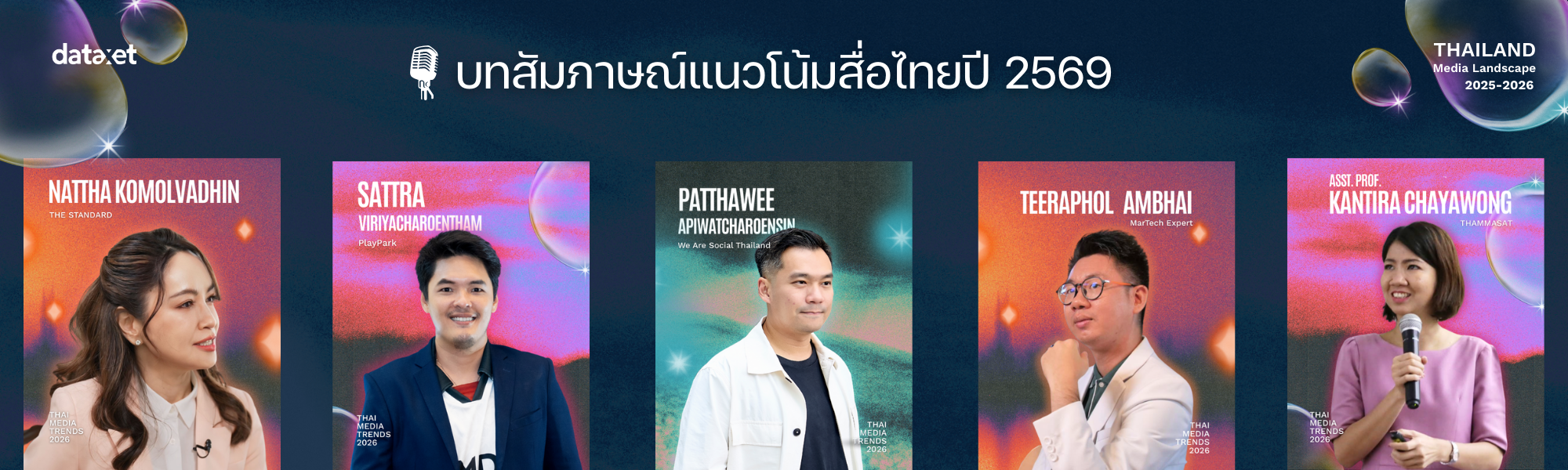
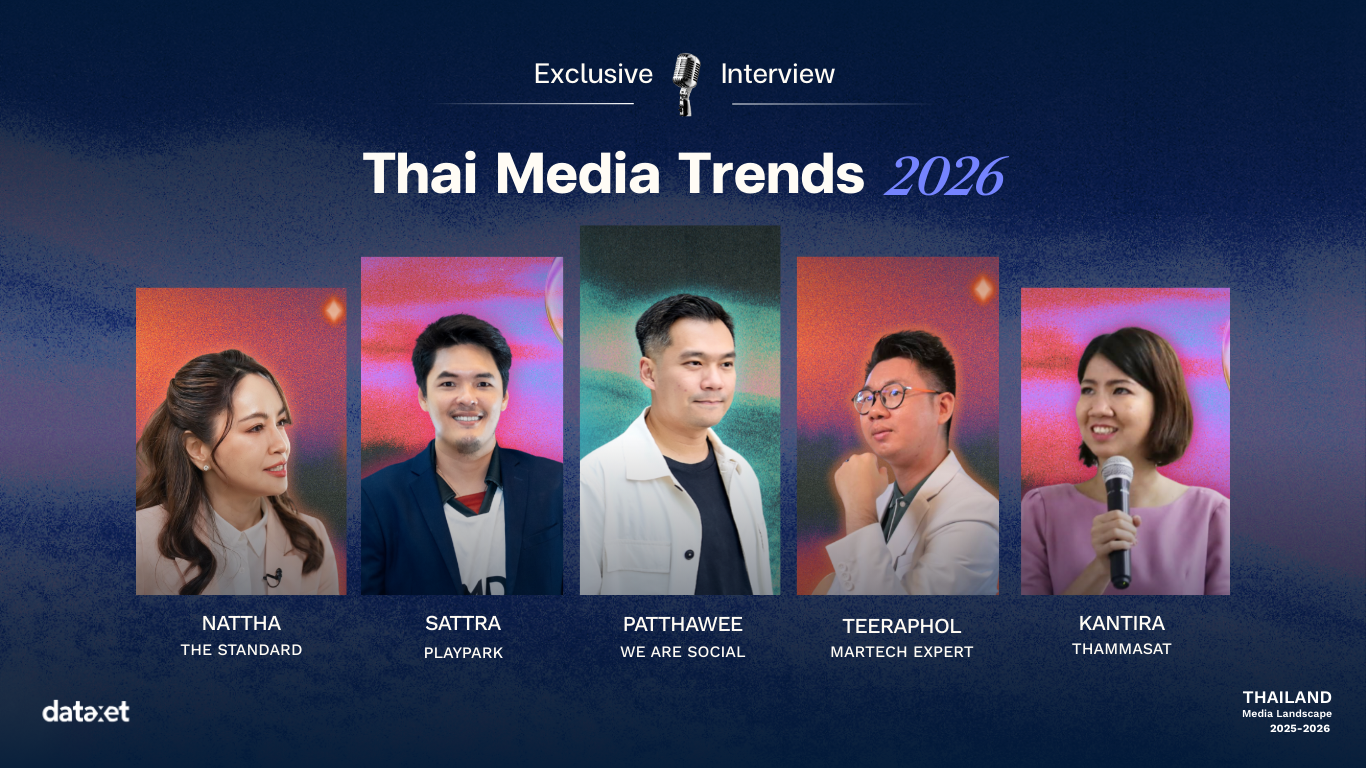
This Thailand Media Landscape 2025–2026 by Dataxet Limited brings together a comprehensive overview of key developments, trends, and directions shaping Thailand’s media industry. Through in-depth analysis and exclusive interviews with industry experts, the report aims to help brands, marketers, and media professionals identify opportunities and navigate change in a media environment that will never be the same.
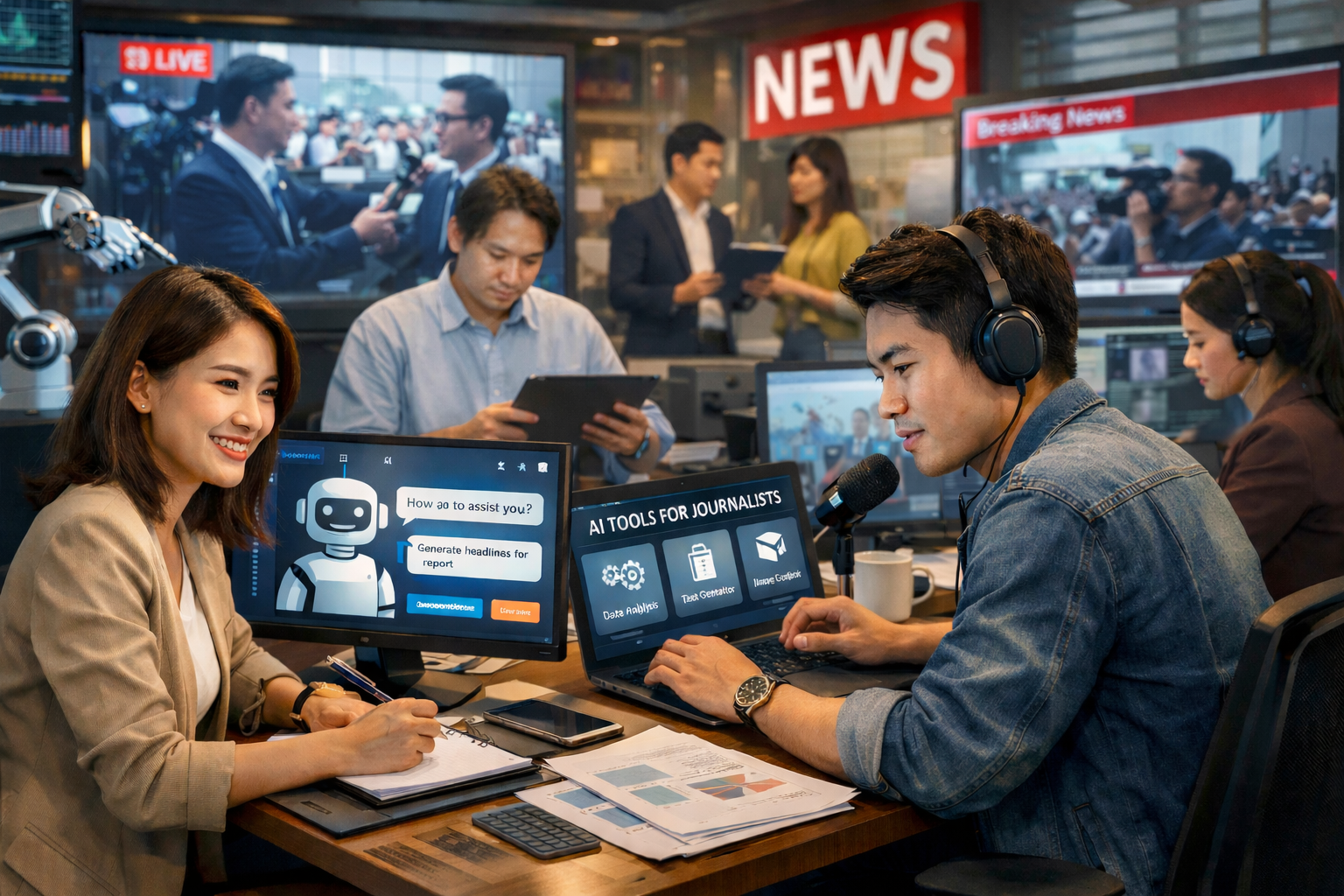
AI as a “Professional Assistant” in Thai Newsrooms Amid the Battle for Credibility
Thai newsrooms have entered the AI era in earnest. A survey on AI adoption across 20 media organizations, conducted by Media Alert under the Thai Media Fund in collaboration with SPRiNG, found that 100% of Thai media outlets surveyed have already integrated AI into their workflows. The most widely used tool is ChatGPT (100%), followed by Gemini (75%) and Claude AI (45%). However, while AI enhances efficiency, humans must still serve as gatekeepers, performing final content screening before publication.
Meanwhile, the emergence of AI Search and Google AI Overview has fundamentally changed how people access news and media business models. Previously requiring long keyword searches, users can now pose shorter questions yet receive more comprehensive answers, as AI can summarize search results on a single page. This has led to a significant decline in click-through rates (CTR) to websites.
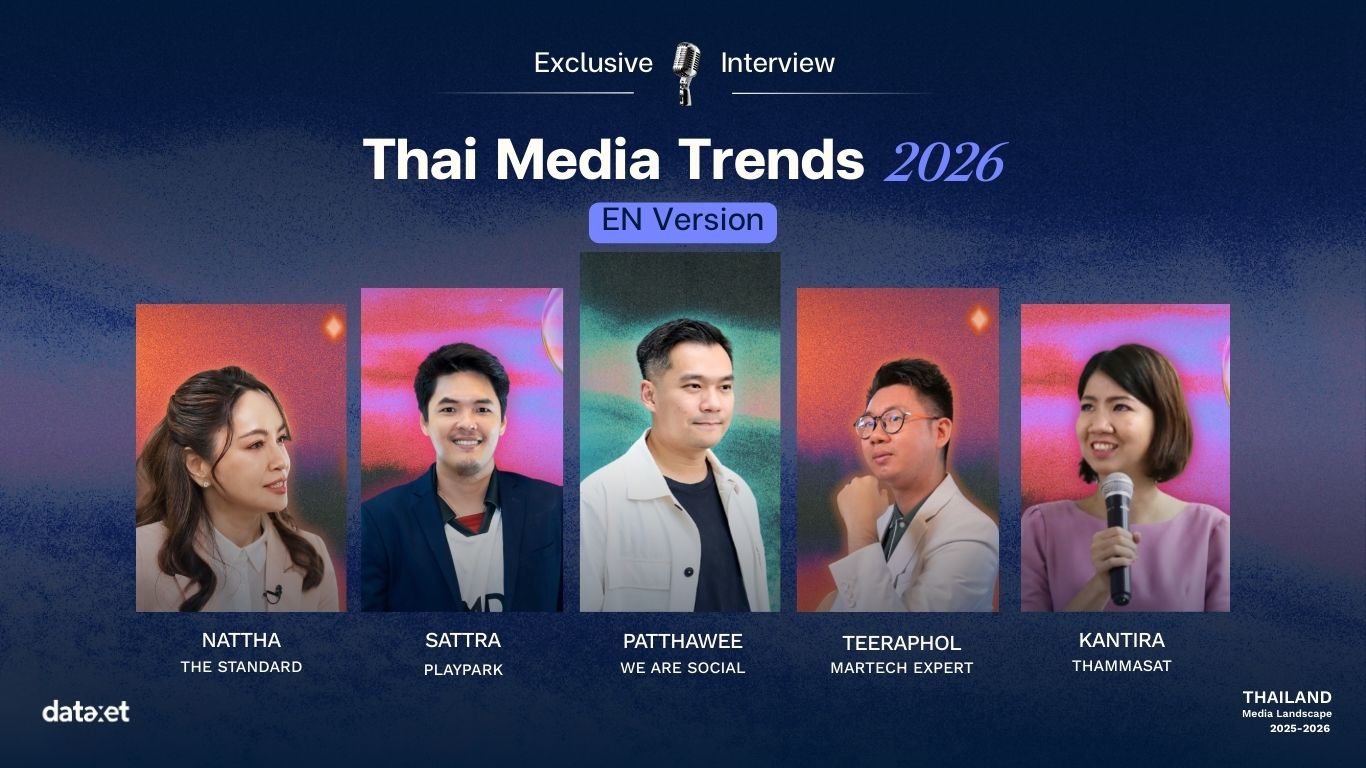
Teeraphol Ambhai, a MarTech expert, shared in an interview with Dataxet that businesses must shift from keyword-centric content strategies to customer-centric approaches to survive and grow in this AI-driven landscape.
For news organizations, credibility is the most critical asset, as AI Search primarily references trusted sources. Producing high-quality, original content not only helps retain readership but also increases the likelihood of being cited by AI—becoming a new form of reputational capital. prioritizing authoritative and verified sources
Nattha Komolvadhin, News Director of The Standard, noted that while Google AI Overview presents significant challenges for news organizations, it also comes with an opportunity to elevate content quality and originality, increasing the chances that AI will choose to cite the news agency’s name as a reference.
Video and Live Streaming Dominate Thai Social Media Usage
Social media remains central to Thai people’s digital lives. According to the Digital 2026: Thailand report by We Are Social and Meltwater, Thailand has 56.6 million social media accounts, representing 79.1% of the total population, with an average of 2 hours and 35 minutes spent daily on social media.
Current Thai social media behavior is not confined to any single platform.
The Thailand Digital Landscape 2025 report by AnyMind Group shows that Thai people consume multiple content formats throughout the day—from short videos and long-form videos to live streams—across various platforms that serve different needs.

Facebook and LINE continue to serve as primary spaces for daily communication among Thai people, while YouTube and TikTok have become the main platforms for video content consumption.
This aligns with Thai consumer behavior, particularly the preference for vertical and short-form video content, which has become the dominant format on Thai social media for both entertainment as well as news and public discourse.
The Reuters Institute’s Digital News Report 2025 states that nearly two-thirds of younger consumers aged 18–34 use social media as their news source. Thai people are among the few nationalities that “watch” news online (43%) more than “reading” it (32%). The main channels for accessing video content are Facebook, YouTube, and TikTok. Additionally, live streaming and interactive explainer videos are gaining significant popularity among younger audiences, reflecting the appeal of content that blends visuals, audio, and emotional engagement.

This trend aligns with insights from Patthawee Apiwatcharoensin, Associate Director of Strategy at We Are Social Thailand, who described a shift from fragmentation to atomization—where audiences increasingly form niche communities around specific interests and passions. While traditional social media platforms like Facebook and LINE remain relevant, their role has evolved from spaces for connecting with friends to community hubs focused on deeper engagement within interest-based groups rather than acquiring new users.
Influencer Growth Continues: Micro and Nano-Influencers Lead Toward Actual Sales Conversions
Statista projects Thailand’s influencer advertising market to reach USD 94.13 million in 2025, with a compound annual growth rate of 13.87% through 2030, potentially expanding to USD 180.23 million. This reflects businesses’ continued reliance on influencers as a core channel for reaching consumers.
The main growth driver comes from micro-influencers (10,000–100,000 followers) and nano-influencers (under 10,000 followers). As consumer behavior becomes increasingly atomized, audiences tend to trust smaller influencers who feel more authentic and relatable. According to IdeasLabs, these smaller influencers collectively account for 71.5% of market share, prompting brands to allocate more budget toward them due to their stronger impact on purchase decisions compared to top-tier celebrities.

Patthawee Apiwatcharoensin from We Are Social (Thailand) Ltd. explained to Dataxet that community-based marketing has become a key strategy, with brands increasingly selecting “tribe leaders”—individuals whose voices carry real influence within specific communities, regardless of follower count.
A clear example is gaming influencers. Sattra Viriyacharoentham, Managing Director (Thailand) of Playpark Co., Ltd., noted that gaming influencers play a crucial role—emerging as a top-tier influence within the gaming sector—because gamers need game reviews to inform their download decisions. These influencers have highly engaged fan bases, with some having more followers than celebrities. The gaming industry allocates its second-largest advertising budget to influencers, second only to Facebook or Google ads.

A major development in 2025 that cannot be overlooked is the “Jenny Festival,” which created a phenomenon that shook the industry through live commerce and affiliate marketing, generating massive revenue for both brands and influencers themselves. This reinforced the evolving role of influencers as powerful media channels and business partners for companies seeking to truly win in the Creator Economy.
Assist. Prof. Kantira Chayawong, Ph.D., Faculty of Journalism and Mass Communication, Thammasat University, told Dataxet that Jenny’s success extends beyond selling products. She functioned as a “market owner,” connecting brands with consumers and creating a new “shopping experience” through live streaming. This represents the emergence of a new “consumer behavior,” where watching shopping live streams becomes a form of entertainment and social interaction, not just about making purchases. At the same time, this enables brands to build their own audiences and businesses, creating a mutually beneficial ecosystem.
Gaming: From Entertainment to Social Communities for the Next Generation
Gaming is no longer a niche form of entertainment; it has emerged as a primary platform competing for consumer time and attention, particularly among Gen Z and Gen Alpha, who use games as social spaces.
Digital 2026: Thailand reports that 77.9% of Thai internet users play video games, spending an average of 8 hours and 53 minutes per week across mobile, PC, and console platforms. Gaming now rivals social media and video platforms in reach.

Sattra Viriyacharoentham of PlayPark noted that Thailand’s gaming market is valued at approximately USD 1 billion, with around 30 million gamers playing at least one hour per day. RPG players spend an average of THB 2,500–3,000 per month, while digital entertainment games serve as community hubs, particularly for Gen Alpha.
Recognizing this opportunity, brands have begun entering gaming spaces. Examples include:
- Garnier Men partnered with popular game Free Fire for “The Rescue Airdrop” campaign to reach Gen Z gamers using gamification strategies that connected Garnier Men AcnoFight skincare products with gameplay. They also became the official Skincare Partner for the FC Mobile Festival 2025 e-sports tournament organized by EA Sports in Thailand for the first time.
- KFC Thailand collaborated with Free Fire to launch the special “BOOYAH Box” menu, allowing gamers to redeem exclusive in-game items.
- Balenciaga made history as the first luxury brand to partner with global gaming franchise PUBG, offering exclusive in-game merchandise and expanding into the real world with branded collection merchandise and special events in Thailand.
Local Content: A Strategic Weapon in the Streaming Wars
The Digital 2026: Thailand report reveals that 70.7% of Thai internet users aged 16+ watch television via streaming platforms, spending an average of 4 hours and 35 minutes per week, with 33.2% of monthly online content purchases going to streaming. This aligns with the latest report from Media Partners Asia (MPA), which states that Thailand has emerged as Southeast Asia’s largest SVOD (Subscription Video on Demand) market in terms of both revenue and subscriber growth, as Thai consumers are among Asia’s most willing to pay for premium content.

“Thai-flavored” local content has thus become a critical competitive advantage. Global platforms such as Netflix, Disney+, and Amazon Prime Video are investing heavily in Thai original productions to satisfy “Thai sensibilities,” as imported foreign content may not fully resonate or create emotional connections like local content does.
Thai content that has succeeded not only domestically but also built strong international audiences includes BL (Boys’ Love) and GL (Girls’ Love) series, which have become powerful soft power with a market value of 5 billion baht annually, commanding 53% of Asia’s BL series market share and being licensed to over 190 countries, responding to the growing global trend of “Asian storytelling.”

Assist. Prof. Kantira Chayawong, Ph.D. from Thammasat University’s Faculty of Journalism and Mass Communication emphasized that Thailand’s large, highly engaged audience and strong emotional connection to storytelling make the market especially attractive, highlighting the global competitiveness of Thai content creators.
Like BL or GL series—besides selling to regular TV viewers or streaming audiences, they can also sell in international markets,”
said Assist. Prof. Kantira.
Radio & Podcasts: The Transition from Analog Dials to Digital Displays
2025 marked a seismic year for Thai radio with the closure of Tero Radio after more than 35 years. This resulted in legendary international music station EAZY FM 102.5’s shutdown, signaling the end of mass commercial radio.
While traditional radio fades, podcasts are growing rapidly and entering a Video-First era.
Digital 2026: Thailand shows that Thais now spend 2 hours and 23 minutes per day listening to podcasts, up from 1 hour and 1 minute in 2024. YouGov ranks Thailand among Asia-Pacific’s most podcast-engaged markets.

This momentum is driven by younger generations. Research on Behaviors and Factors Affecting Podcast Listening Among Gen Z in Thailand reveals regular listening patterns, typically 2–3 times per week before bedtime. This reflects podcasts’ evolution from alternative audio media to becoming part of digital consumers’ daily lives.
Notably, the research found YouTube is the primary podcast platform for 89.75% of Gen Z listeners, highlighting that podcasts are no longer limited to audio but have evolved into multi-platform content that can be “watched” and “shared.”
Television: Seeking Revenue Beyond the Screen
Thailand’s television industry continues facing ongoing challenges as advertising revenue—its primary income source—declines annually. MI GROUP projects TV ad spending at THB 31.1 billion in 2025, falling to THB 29.0 billion in 2026 due to Thailand’s slow economic growth.
This situation has pushed TV channels to urgently seek non-TV revenue streams. The One Enterprise PCL, owner of one31, is a successful example of transforming revenue from on-screen to “off-screen,” as revenue from Idol Marketing (artist management and events) surpassed Content Marketing revenue (advertising and licensing) for the first time in Q3 2025.

Meanwhile, BEC World Public Company Limited (BEC), operator of Channel 3, is also seeing positive signs from alternative revenue. While advertising time sales decreased 13%, licensing and other service revenue grew 7.7% against the trend. This growth was significantly driven by artist management and fan events, with the success of GL series Only You and the “Ling-Orm” pairing helping extend on-screen revenue to international fan meetings and building long-term fan bases.
However, without clearer regulatory direction, these efforts may remain short-term solutions. As broadcast licenses approach expiration in 2029, delays in NBTC’s regulatory roadmaps and spectrum allocation pose significant risks to long-term industry sustainability.
Thailand Media Landscape Overview
Thailand’s media landscape in 2025-2026 reflects clear structural transformation as consumers shift attention to highly personalized content (hyper-personalization). We see growth in “Thai-flavored” local content on streaming platforms, gaming’s expanding role as a social space for younger generations, and social media’s evolution from communication spaces to platforms driven by communities and niche engagement.
On the other hand, traditional media like TV and radio continue facing pressure from shrinking advertising budgets, forcing operators to transform from “broadcast media” to using screens as starting points for revenue extension through artist businesses, events, and fan community activities. Meanwhile, podcasts are growing in the opposite direction, entering a video-first era to meet on-screen content consumption behaviors.
For influencers and creators, the growth of micro and nano-influencers reflects a shift from measuring success by follower counts to the power of relationships and credibility within communities. Social commerce and live commerce have become crucial mechanisms for actual sales conversions, with AI becoming the new infrastructure for production, content distribution, and marketing.
Ultimately, 2026 will reinforce that “quality” and “credibility” are the heart of media in the AI era amid information overload.
Media and creators who can blend technology with original content and genuinely build audience relationships will stand the test of time and grow sustainably in Thailand’s transformed media landscape. Because in an era where AI can do almost everything, being human is what still truly matters.
Topics

- แนวโน้มสื่อไทย 2569
- ภูมิทัศน์สื่อไทยปี 2569
- แนวโน้มสื่อไทย 2568
- ภูมิทัศน์สื่อไทยปี 2568
- ภูมิทัศน์สื่อไทยปี 2567
- ภูมิทัศน์สื่อไทยปี 2566
- ภูมิทัศน์สื่อไทยปี 2565
- ภูมิทัศน์สื่อไทยปี 2564
- ภูมิทัศน์สื่อไทยปี 2563
- Thai Media Trends 2026 (English Version)
- Thailand Media Landscape 2025-2026 (English Version)
- Thai Media Trends 2025 (English Version)
- Thailand Media Landscape 2024-2025 (English Version)
- Thailand Media Landscape 2023-2024 (English Version)
- Thailand Media Landscape 2022-2023 (English Version)
- Thailand Media Landscape 2021-2022 (English Version)